
Person-centered care
Understanding Dementia & the Person
Identify one ability, one preference and one environmental support before choosing a caregiving approach.
DEMENTIA CAREGIVING / PROFESSIONAL TRAINING SAMPLES
Practical dementia-caregiver skills for communication, daily personal care, meaningful activities, safety, and caregiver strain. Six real lessons and competency practice pages are available free.
Preview real training lessons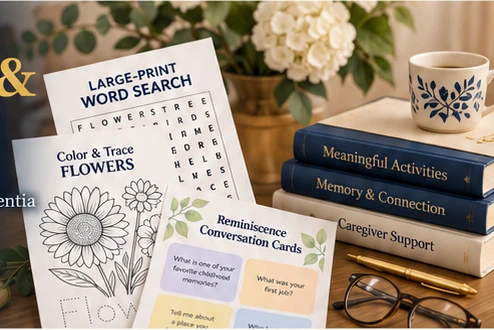
Training preview library
Each two-page sample teaches the behavior, explains how to demonstrate it, presents a realistic situation for role-play, and includes observation criteria. These are genuine downloadable teaching resources, not placeholder curriculum cards.
Identify one ability, one preference and one environmental support before choosing a caregiving approach.
Demonstrate a clear, calm response to repeated questions without arguing or memory-testing.
Plan a respectful personal-care approach that protects consent, comfort, dignity and safety.
Choose an activity by interest and ability and adapt it after observing response.
Follow an individualized getting-lost response plan and report meaningful changes in condition.
Identify overload, request concrete coverage and distinguish worker-support duties from family-caregiver relief.
Sample practical teaching sequence
A person asks, “When is my daughter coming?” repeatedly. Rather than saying, “I already told you,” the caregiver acknowledges the worry, answers briefly when appropriate, and offers a calming next step. If distress is new or significantly worse, they notify the proper supervisor or clinical resource under the care plan.
Notice voice, expression, noise, and urgency.
Approach calmly, acknowledge the feeling and speak simply.
Allow response time; avoid correcting or arguing.
Evaluate comfort and seek help when concern escalates.
Practice the response with an instructor and receive feedback.
Caregiver strain and burnout
Supervisors should examine workload, task complexity, missed breaks, shift coverage, training, and whether an assignment has become unsafe. A worker should know how to report concerns and request specific assistance without having to solve staffing shortages alone.
Identify one concrete need: an hour of coverage, a meal, transportation, or help arranging respite. Ask local aging services or a qualified care organization about available caregiver supports. Activities can be shared, but they do not replace time away and help.
These HCTP materials are original educational examples informed by recognized dementia-care guidance. Adapt activities to the person and the agency's care plan; do not use worksheets to test, diagnose or claim treatment of cognitive decline.
Yes. Every PDF in this introductory library is free, without a purchase or email registration. Some include a separate caregiver answer key.
You can open downloaded PDFs in a compatible iPad PDF annotation app and draw or color there. They are not a native tap-to-fill coloring application.
No activity is suitable for everyone by diagnosis or stage alone. Choose according to interests, current abilities, comfort and safety; offer gentle conversation, observation or quiet companionship instead of a puzzle when appropriate.
These resources support enjoyable participation and connection. They are not presented as preventing, reversing or slowing dementia.
No. These are genuine sample teaching lessons and competency practice sheets, not an accredited certification, state approval or continuing-education credit. The full program remains in development.